
Informal Waste Reclaimers (waste pickers) - About Us
Who we are and what we do.
Who we are:
Waste reclaimers engage in collecting recyclable materials which we sell for subsistence and survival. Coming from disadvantaged backgrounds of poverty and unemployment we strive to earn a legitimate livelihood from salvaging and selling recyclable materials from waste.
Benefits to what we do:
Waste reclaiming provides a steady income to sustain reclaimers and our families and is beneficial to the environment. Pollution is reduced, and the life span of the landfill sites are extended, which saves municipalities money and other resources which could be used to commission new landfill sites. It is beneficial both to the reclaimer and to the environment. Reclaimers form an essential service and are an integral, although frequently unacknowledged part of the waste management systems in the cities in which we work. In residential areas such as informal settlements and squatter camps, there are often no formal refuse removal systems in place. In such areas waste reclaimers have the potential to contribute significantly to proper waste management and environmental health by collecting, sorting, selling waste materials.
Issues we face:
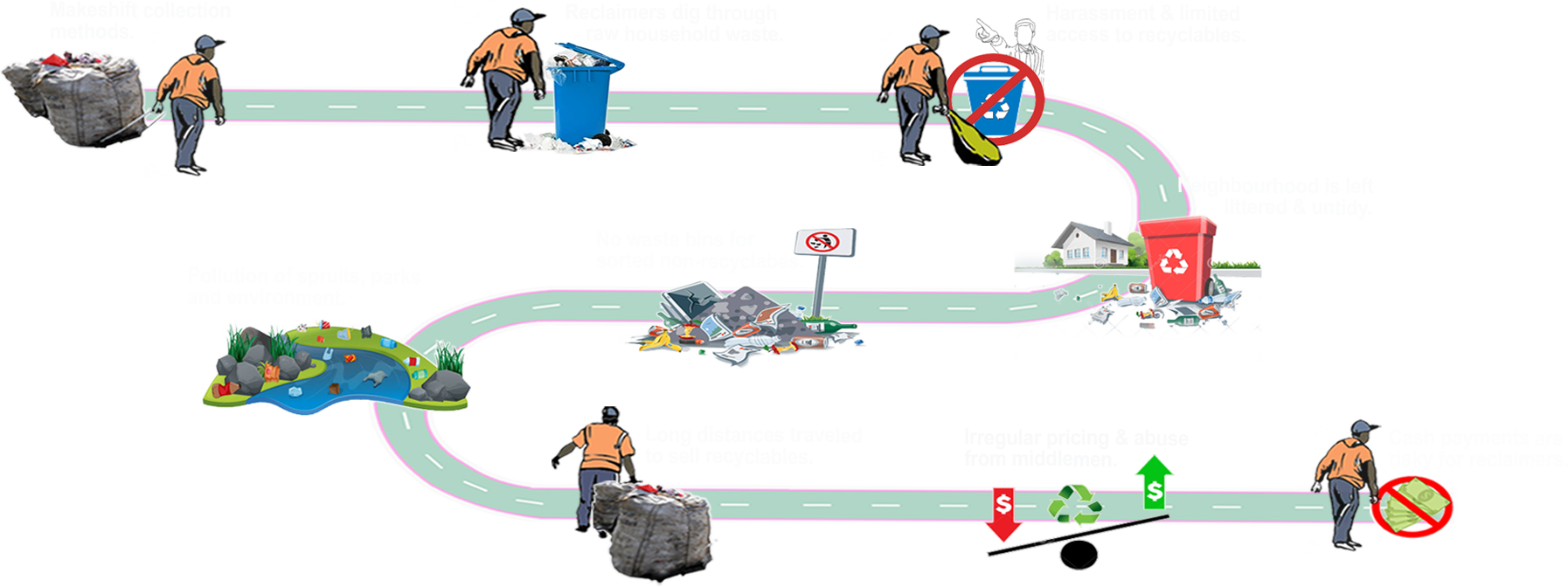
Waste reclaimers are subject to social stigma, face poor working conditions and are frequently harassed. Non organised waste reclaimers are often exploited by middlemen. Exposure to chemicals and toxic substances put reclaimers lives at risk.
Informal waste reclaiming issues
We have solutions to these issues, see under our Solutions menu.
Statistics
Informal reclaiming statistics in South Africa

80% to 90% of plastic and paper waste recycled in South Africa, is recycled by informal reclaimers.

Each informal reclaimer diverts up to 24 tons of recyclable waste a year from our country’s landfills.

Informal reclaimers have saved municipalities hundreds of millions of Rand in landfill space annually.

Reclaimers are subject to social stigma, face poor working conditions, are frequently harassed and are not seen as part of official recycling systems.

More than 140,000 informal reclaimers in South Africa make a living by collecting, sorting and selling recyclable waste.

The recycling sector has been growing at an average annual rate of 23% over the past few years.

Waste reclaiming is self-sustainable and helps improve the environment.

Informal reclaimers provide an environmental service for free.
Why is supporting informal waste reclaimers so important.
Informal waste reclaimers are often excluded from formal systems, despite being essential to recycling in South Africa. They are historically marginalised and often face social, political and economic exclusion.
Supporting reclaimers is not only about improving recycling rates — it’s also about fairness, inclusion and sustainable development. Reclaimers contribute labour, knowledge and daily effort to the circular economy. Without support, equipment or recognition, their impact is limited. With the right backing, their work can create large-scale employment, especially for youth and women, and help reduce poverty.
Our inclusive recycling model brings the human side into the circular economy. It focuses on creating livelihoods, not just processing materials. We do this through grassroots partnerships, training, shared infrastructure and better access to recyclables.
We promote formal partnerships between reclaimers and public or private stakeholders. This gives reclaimers more security, fairer contracts, and a stronger voice. When reclaimers organise into cooperatives, they demonstrate how waste work can be part of a social and solidarity economy — one that supports environmental, economic and social goals.


